
What Boston Resident Records Confirm
A Boston resident lookup is a corroboration process, not one master directory. A Boston address-keyed parcel record can show a current owner display, situs address, mailing address, taxes, exemptions, and value. A Boston deed can place a grantor or grantee in a recorded transfer. A Boston court docket can show a party and case activity, while a Boston vital or probate record can support an event or family relationship. Each Boston source has its own access limit. Use the source that directly answers the question, then compare at least two independent details before treating a match as reliable.
| Boston record | Question it can answer | Official keeper | Access boundary |
|---|---|---|---|
| Property and tax parcel | Current owner display, property address, mailing address, value, taxes, exemptions | Boston Property Lookup | Free address or 10-digit parcel-ID search; no owner-name search |
| Boston recorded deed | Grantor, grantee, transfer date, legal description, book and page | Suffolk County Registry of Deeds | Name, address, book, and date paths; online name index begins in 1973 |
| Boston voter status | Whether an individual voter is registered and related voting-location information | Massachusetts voter status | Individual name, date of birth, ZIP, and agreement only |
| Boston court docket | Party name, case number, court, events, and disposition | MassCourts | Public lead; clerk file is authoritative and protected matters are limited |
| Vital and probate record | Life event, decedent, fiduciary, estate, will, or relationship clue | Boston Registry, RVRS, or Suffolk Probate and Family Court | Copy eligibility, identity, relationship, and access rules apply |
Use a Boston address only when it is already known. Boston Property Lookup does not take an owner name, so a name-first search should move to another official trail, such as the voter-status tool, a deed index, a court docket, a business filing, a professional license, or a historical directory. The Boston property display is a lead, not a complete list of everyone connected to an address.
Building a Boston Resident Identity Key
Before searching, make a short Boston identity key: full name, middle initial, approximate age, former address, neighborhood, spouse or parent name, and likely years. An occupation or business affiliation can help separate two same-name people, but it should be paired with a date and an address. Boston directory entries may use initials and shortened street names. Suffolk deed searches for Boston property are usually last-name first, the Boston voter form expects the name used at registration, and court results can show more than one party row for a single case number.
Run exact and Boston variant spellings. Try a former Boston ZIP after a move when the voter-status result is missing, as the state's search tips advise. A person may also be absent because the relevant Boston record is restricted, the document uses a legal description rather than a street address, or the person was never listed in that particular record set. The strongest Boston result ties two independent fields together, such as a dated address and a spouse notation, a court number and court location, or a deed book and named party.
Note: Do not treat an unverified same-name result as a current address or identity match, even when a record looks close.
Using MassCourts for Boston Residents
MassCourts is the Boston public entry point for Boston Municipal Court, Suffolk Superior Court, Suffolk Probate and Family Court, Land Court, and other Massachusetts Trial Court departments. The opening screen requires a reCAPTCHA before Boston public-record search. Then choose the Boston court department, division, location where required, and result count. Boston search modes are Name, Case Type, Case Number, and Ticket or Citation Number. The internet instructions limit civil name searching, so use a case number or the clerk when the name route is unavailable.
MassCourts public search begins with the statewide court-record entry screen.
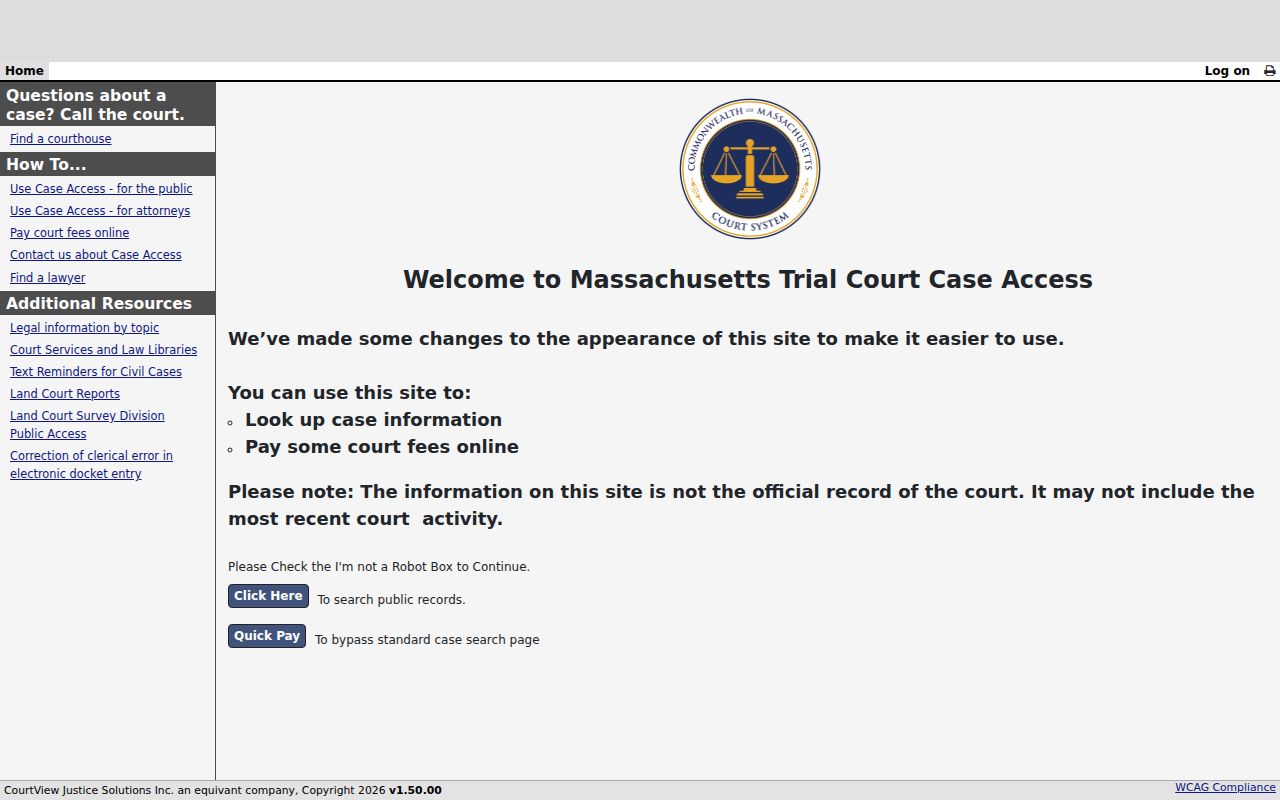
The Boston court selection comes before the search method. Select the department carefully because it controls the available fields and local options.
| Court Department | Required dropdown that controls the next court choices. |
|---|---|
| Court Division | Required dropdown with options that depend on the selected department. |
| Court Location | Conditional control that may appear or auto-populate for the chosen court. |
| Name tab | For civil internet search, use at least two characters with an initial capital and lower-case letters. |
| Case Type dates | Begin and end dates are required for that mode, with a range no longer than one month. |
| Case Number | Use exact capitalization, spacing, and leading zeros. |
A Boston case link can show party, event, docket, and disposition information, but a Boston result is not the official Trial Court file. Some public documents or images may appear depending on court and case type. Boston courthouse kiosks can display information beyond the home internet path, and the Boston clerk, register, or recorder at the filing location keeps the authoritative file.
Boston MassCourts search guidance explains the tabs, field limits, correction route, and official-file caveat.
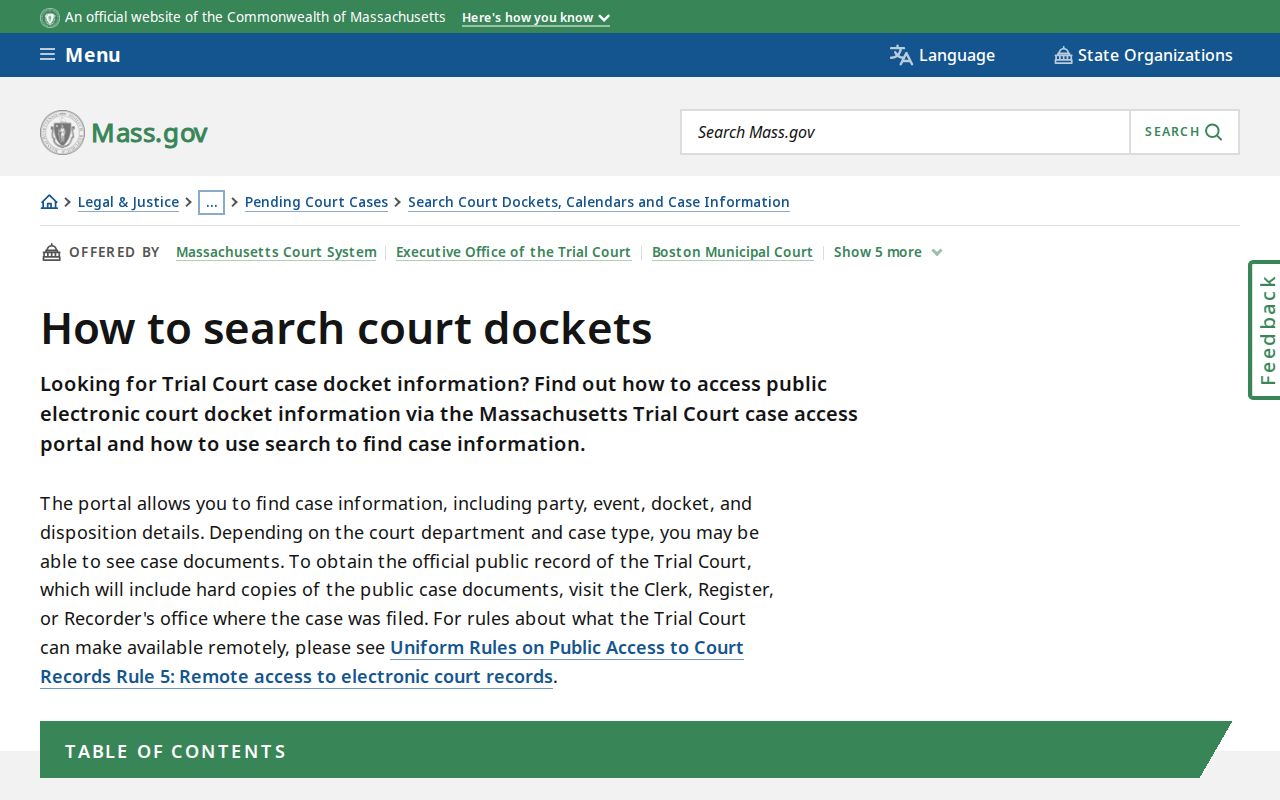
Use the Boston screen as a record trail, then request the official file from the correct clerk when a certified or complete court record is needed.
Verifying a Boston Resident Across Records
Boston verification begins by anchoring a name to a dated record, not by collecting every possible result. If a Boston address is known, use the parcel display to capture the parcel identifier and the name shown there. If the question concerns a Boston deed, follow the grantor or grantee entries at the Suffolk County Registry of Deeds. For a Boston court lead, retain the exact case number, department, division, and filing location. Then compare the second record with the first. A shared name without a shared date, address, family relationship, or court identifier remains a lead.
- Write the full name, Boston spelling variants, middle initial, known address or neighborhood, and the dates that fit the person.
- Use the Boston official source most closely tied to that starting fact, such as the parcel portal for a known property or MassCourts for a case lead.
- Record the Boston identifier the source gives, including a parcel ID, book and page, case number, or directory volume and page.
- Check a second Boston official source for a matching address, year, relationship, or other independent field.
- Request a custodian copy only when the source rules permit it and the question genuinely requires the official record.
- Docket
- A court's dated list of filings and events in one case, identified by a case number.
- Index and image
- An index points to a record. An image is a scan of the underlying document, when the custodian makes one available.
- Certified copy
- A copy issued and certified by the custodian as an official record, subject to that office's eligibility and fee rules.
Boston MassCourts results commonly show party name, case number, department, division, location, case type, event dates, docket entries, and disposition where available. Protected, sealed, impounded, juvenile, adoption, and similar material is not an ordinary public search result. In Boston Probate and Family Court, party addresses are also omitted from remote access under the current order.
Boston Voter Status Lookup
The Massachusetts Find my voter registration status tool is an individual status check for a Boston voter, not a Boston residents directory. It requires first name, last name, birth month, day, year, the five-digit residential ZIP, and an agreement checkbox. A result can confirm Boston registration status and voting-location information for the individual. It does not expose the full central voter registry, which Massachusetts law does not treat as a general public record.
Massachusetts voter lookup shows the individual-status fields that must be supplied.
Use the Boston registered spelling, and try a former Boston ZIP after a move if the first search misses. Allow two or three weeks after a new registration before treating a not-found result as final.
For a lawful historical or election purpose that needs a particular local list, contact the Boston Election Department at City Hall, Room 241, by phone at 617-635-8683, or at its counter. Its Boston annual resident listing and address-confirmation process can change a voter to inactive when a response is not returned. Ballot choices, full dates of birth, identity numbers, and protected Boston addresses do not appear in the individual tool.
Boston Vital and Probate Trails
Boston's Registry Division handles Boston birth, death, and marriage certificates and marriage licenses, while the Massachusetts Registry of Vital Records and Statistics issues statewide certified copies for 1936 forward. Neither office offers a public online browse index for Boston certificates. A requester needs the subject, event date, and place, plus identification and sometimes relationship documentation. Boston accepts online, mail, and counter orders. Recent Boston records and births to unmarried parents can be restricted, ordinary birth and marriage access uses a 90-year rule, and ordinary death access uses a 50-year rule.
Boston Registry Division provides local ordering routes. For a statewide order, use the Massachusetts vital-record ordering process. Boston certified records begin in 1870; earlier Boston work moves to non-certified City Archives copies, eligible Massachusetts Archives material, or genealogical sources. A full Social Security number on a Boston death record is restricted to legitimate-need requesters under the July 1, 2026 rule.
When a deceased person is the key to a Boston family or property question, search Suffolk Probate and Family Court by decedent name and docket. A Boston estate record can identify a fiduciary, will, heirs, or an executor's deed trail. The online docket is only a lead. Probate copy requests go through the court and work best with the docket number; remote party addresses can be restricted even when other case information is public.
Note: A certified vital copy confirms an event held by its custodian, while a probate docket may point to related people without supplying every protected detail.
Boston Records Request Fallbacks
When a Boston online search stops, use the office that keeps the missing record. Boston's Registry has counter, mail, and online certificate routes. The Suffolk Registry of Deeds in Boston provides its recent online index, older book and page paths, and counter research. A Boston court clerk holds the official case file. The Boston Public Library can route historical searches to directories, obituary citations, newspapers, maps, and microfilm. The Boston City Archives, Massachusetts Archives, and NARA Boston are the next repositories for older municipal, state, or federal material. The historical shelf is covered in more depth in the Boston city directory collections.
A narrow written Boston request under the Massachusetts Public Records Law should name the custodian, record type, date range, desired format, and delivery method. M.G.L. c. 66 §10 generally requires a written response within 10 business days. The first four staff hours are generally free, later labor is capped at $25 per hour, and standard black-and-white copies are generally capped at $0.05 per page. A denial should identify the exemption and the appeal route. Boston judicial records follow court rules and clerk procedures rather than the executive-branch records process.
Massachusetts public-records request guidance outlines the written-request process, exemptions, and response rule.
A focused Boston request is more useful than asking for every record about a person. It also helps the records access officer determine which non-exempt material, if any, the office holds.
Boston Resident Lookup Privacy Boundaries
Boston privacy rules are record-specific. The Public Records Law does not override a statute that makes information confidential. Boston birth information has separate protections, the voter central registry is not a general public record, and state court rules applied in Boston limit sealed, impounded, juvenile, adoption, and protected-person material. The Massachusetts Address Confidentiality Program provides a substitute address and mail forwarding for qualifying survivors of domestic violence, sexual assault, or stalking, as well as certain legally protected health-care providers. A protected absence should never be read as proof that a person is not in Boston.
Lawful use. Boston resident lookup records are for lawful personal, family-history, civic, or consumer-safety research. Using a record to stalk, harass, threaten, or intimidate someone can violate Massachusetts law.
The correct response to a suspected error is to contact the custodian. MassCourts supplies a correction process for court information, and a public-record request can be narrowed or appealed through the prescribed route. Stop when a search would intrude on personal safety or crosses a confidentiality boundary.