
Boston Previous Residents by Era
One Boston address has different useful sources across city and county record systems at different points in time. Start with the current parcel when the question concerns a recent transfer. For an earlier household, a Boston city directory or street section may be the better entry point. The Suffolk Registry of Deeds holds the ownership record, while the Boston Public Library, Boston City Archives, and archival collections supply names, occupations, address forms, maps, tax books, and newspaper citations. The table separates those roles so a name in one source is not confused with proof supplied by another.
| Source | Period covered | Where held | What it can show |
|---|---|---|---|
| Boston parcel record | Current display | Boston Property Lookup | Situs, owner display, mailing address, parcel ID, tax and exemption data |
| Suffolk Recorded Land name index for Boston property | 1973 forward, beginning with Book 8595 | Massachusetts Land Records | Grantor, grantee, document date, legal description, book/page, and document reference |
| Older Suffolk deed books | Book images back to 1800, Book 194 | Suffolk Registry research route | Older recorded instruments when a book or page is known |
| Archives deed material | 1629–1800 | Massachusetts Archives | Historic Suffolk deed volumes and grantor/grantee indices |
| Boston directories | 1789–1981, with early gaps | BPL, Tufts, Internet Archive, and related collections | Names, street addresses, occupations, and address sections in applicable years |
| Federal census schedules | 1850–1950 available Boston household trail | NARA and library databases | Names, ages, relationships, birthplace, and recorded address detail where supplied |
| Tax books | 1780–1821 | BPL digitized microfilm | Ward-by-ward taxpayer and proprietor clues |
| Permit records | Modern online data and historic document-room files | Boston Inspectional Services | Work, applicants, owners, builders, dates, and plans where available |
A Boston deed identifies title, not every person who lived at the address. A Boston directory can tie a named person to an address in a particular year, but its coverage changes by period and household role. Pair the sources rather than expecting one search to answer every question. The historical trail becomes much stronger when the parcel number, old street form, document reference, and directory year all agree.
Boston Parcel Records First
Boston Property Lookup takes a street address or a ten-digit parcel ID, not an owner name. Its Boston assessing overview can display the situs address, current owner or owners, owner mailing address, assessed value, property type, parcel ID, net tax, exemptions, and map link. Record the situs and mailing address separately. The mailing field identifies where tax correspondence is sent, and it may be outside Boston. Neither field alone proves that a named person lived at the parcel.
The parcel ID gives the title search a stable Boston key. Boston forms it by appending the ward number to the parcel number and omitting hyphens. Keep it with MAP_PAR_ID and LOC_ID when the Boston GIS parcel service supplies those identifiers. Condominiums, master parcels, registered land, and parcel consolidations can make one modern street address appear in several records, so a mismatch should be recorded rather than guessed away.
For a building change, search the address in Boston historical permit records. Post-December 15, 2009 data can be searched online, while plans and other older materials can require the Boston Inspectional Services document room. A permit dates work on a building and may supply a useful name, but it is not an occupancy list.
Boston Previous Residents Deed Chain
The title trail begins with the current Boston parcel and then moves from a present owner’s purchase deed to the earlier acquisition by the seller. Suffolk’s online Recorded Land name index is indexed and imaged from 1973, beginning with Book 8595. The Registry says 1970–1972 material is being verified and re-indexed, so it may be unverified. Older images can be reached through book/page or Unindexed Property Search, and the Massachusetts Archives holds the oldest Suffolk volumes. That local boundary is why a backward trail sometimes changes from a name search to book research.
- Pull the Boston parcel record and save the street address, parcel ID, current owner display, and any deed reference.
- Search the current owner as a grantee in Suffolk Massachusetts Land Records, then open the acquisition deed.
- Write down the grantor, grantee, recording date, book/page or document number, legal description, prior-deed reference, and plan reference.
- Search that seller as a grantee to find the earlier purchase, then repeat the sequence.
- At the online boundary, use the cited book/page, Unindexed Property Search, Registry research channel, or Massachusetts Archives material instead of assuming the chain ended.
- Grantor and grantee
- The grantor transfers an interest. The grantee receives it. Their names are the link between successive deed searches.
- Chain of title
- The sequence of recorded transfers and related instruments used to follow ownership of one parcel backward.
- Legal description
- The lot, plan, subdivision, metes-and-bounds, or other property wording in a deed. It can be more stable than a street number.
- Registered land
- Land handled through a certificate of title and Land Court plan references, using templates distinct from recorded land.
Boston’s 1973 Index Boundary
The online name index is a practical Boston dividing line, not the beginning of Suffolk title history. Registry book images reach back to 1800, Book 194, when the researcher knows a book or page or can use the unindexed route. The Massachusetts Archives provides a deeper route for Boston and Suffolk deed material from 1629 through 1800, including grantor and grantee indices. Search instructions also warn that Boston street-address identification becomes less complete the farther back the records go, because older deeds often rely on legal descriptions instead of a modern street address.
The Suffolk Registry offers Boston research and recording channels at 24 New Chardon Street in Boston. Online searching, document viewing, printing, and downloading were free when inspected, while certified copies require a Registry request. A result set is limited to the first 1,000 matching rows, so a broad surname should be narrowed with party role, a date range, a document type, town, or a second party. The current Boston Registry channel, book search, and archival material are separate access paths, not interchangeable copies of one index.
Note: A missing name result can mean that the address is described by lot or plan, not that a past owner never held the parcel.
Boston Previous Residents in Directories
Boston directories make the household layer visible in a way a deed cannot. The sequence began in 1789, was irregular before 1820, and became annual in 1820. BPL reports Boston directory resources across the eighteenth through twentieth centuries, including a digitized Boston run from 1789 to 1975 with gaps and the final regular editions in 1978 and 1981. The Boston address-sorted section became available in 1930, which is especially useful when the street is known before a name.
BPL’s directory genealogy guide explains the chronology, publisher trails, and changing form of Boston entries.
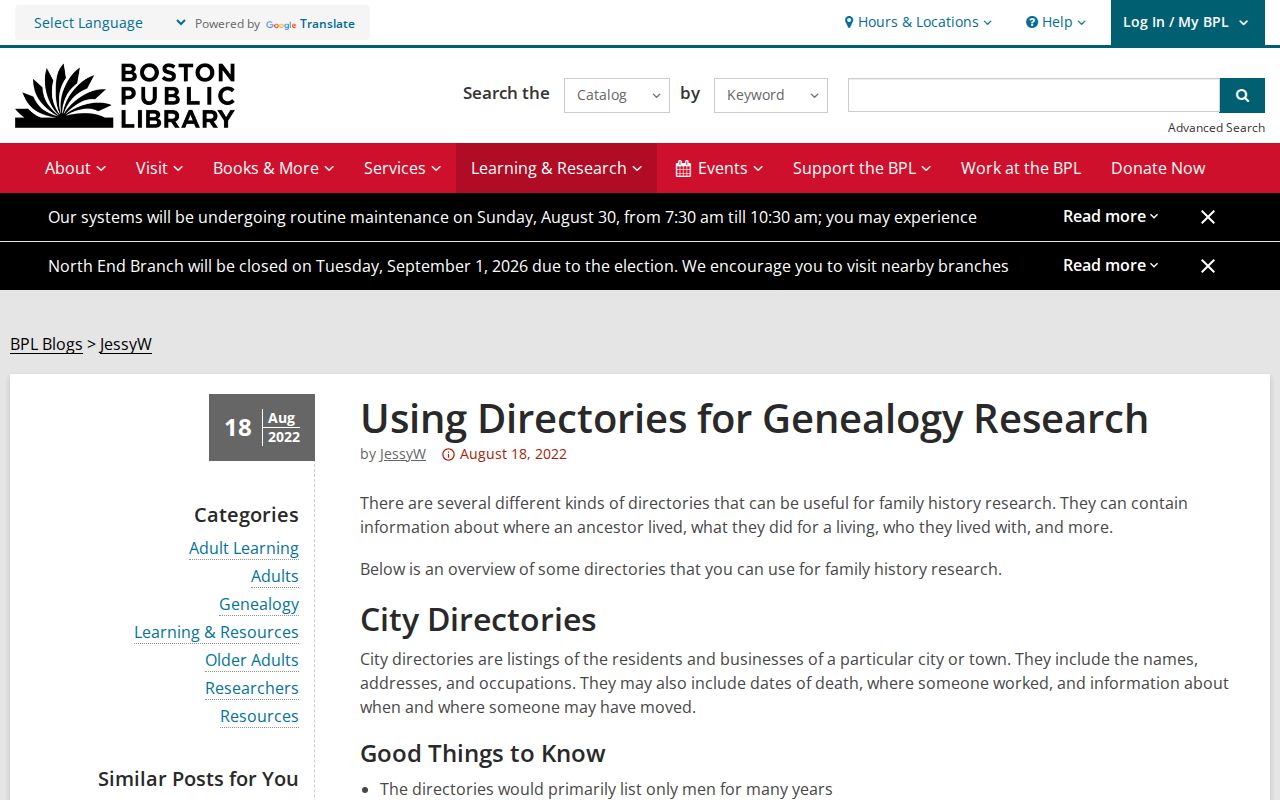
The guide is useful when initials, abbreviations, a widow notation, or a street section must be read in the context of a particular Boston edition.
- Find the address in the closest directory year and copy the spelling, street number, occupation, and any household notation.
- Check one earlier and one later edition for a move, changed number, different initials, or a widow notation.
- When the reverse section exists, search the street as well as the surname.
- Pair a directory year with the nearest available census schedule, then compare the names and address context before treating them as one household.
The full shelves and publisher runs are described with more detail in the Boston city directory material. Here, the goal is a dated address trail rather than a catalogue of every collection.
Boston’s House-History Trail
A Boston historical address often needs a map and a record of the building as well as a name search. BPL recommends connecting Boston directories with Sanborn fire-insurance maps, Boston City Archives material, permits, and deed or tax material. The Library of Congress holds an 1867 Boston Sanborn atlas record with an index and property-owner subjects. Boston Sanborn sheets can show a building footprint, use, street and block numbers, and local changes in the built environment. They help bridge an old street reference to a Boston parcel shape or later renumbered address.
BPL’s Boston house-history guide brings the directory, atlas, archive, and address-continuity steps together.
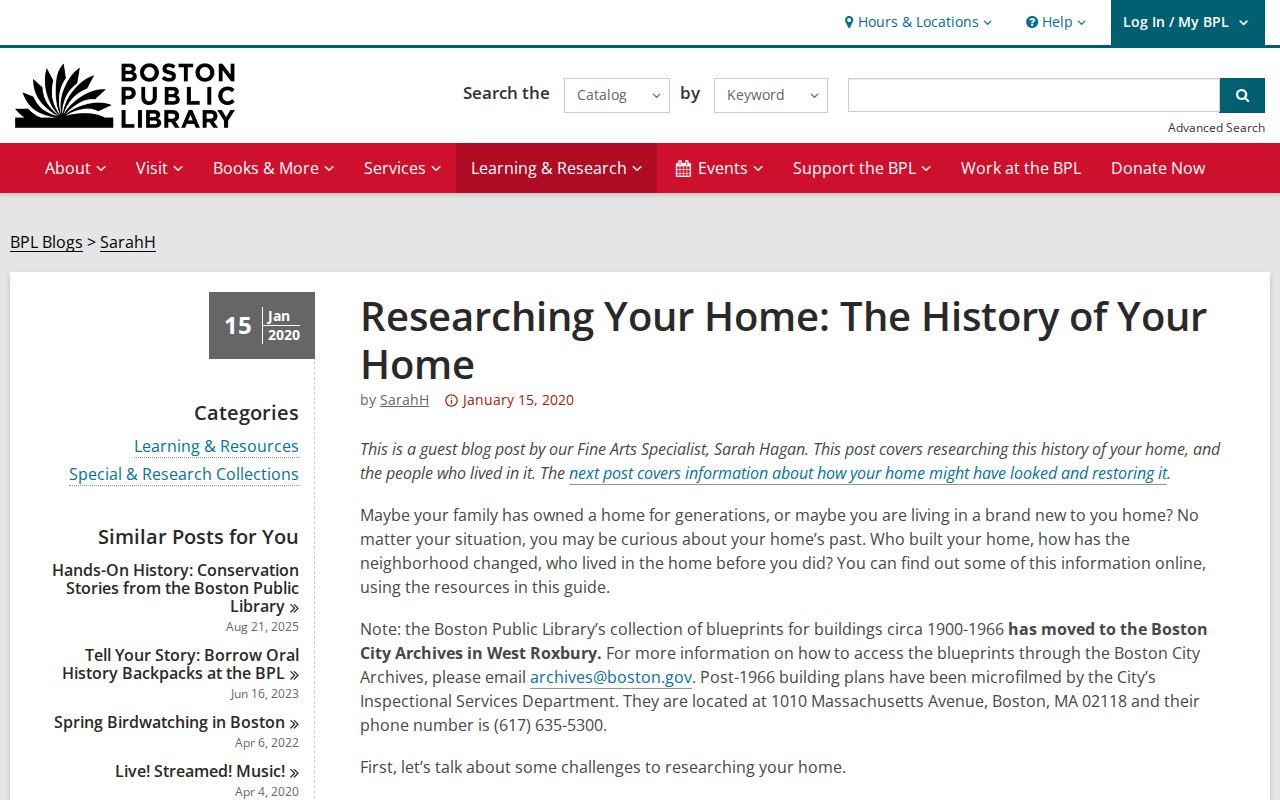
Use that sequence to test whether an older number, street line, and present parcel describe the same place before connecting a household to it.
For an earlier Boston taxpayer, BPL has digitized about 1,350 manuscript Boston tax-record volumes for 1780–1821. Those Boston ward-by-ward books can add a proprietor name before a modern Boston parcel history exists. The Boston Public Library’s Local & Family History Collection in the Elliott Room also supplies maps, microform, newspapers, directories, and research support for a source that is not available online.
Boston Past Households After Annexation
Boston’s borders changed while its record systems were being built. South Boston joined in 1804, East Boston in 1836, Roxbury in 1868, Dorchester and Mattapan in 1870, several West Roxbury-area communities in 1873–1874, and Hyde Park in 1912. A historical address may therefore sit under a former-town name, even though the same place is now treated as a Boston neighborhood. Search the former town along with the current street and neighborhood name.
Boston numbers and road names can shift too. A Boston street may have been extended, renumbered, or indexed under a different municipality. The Boston Election Department preserves an addresses-reassigned resource related to 1992 legislation, which can be a lead when an earlier voter or street-list address does not align with a modern Boston one. A Boston Sanborn sheet, deed legal description, street section, and parcel shape provide better continuity than a simple name match.
Boston Past-Household Record Gaps
Boston’s November 9–10, 1872 Great Fire destroyed more than 1,000 downtown businesses. Surviving Boston City Archives photographs and records document the fire, rebuilding, and altered Boston street fabric. A missing business entry or a changed Boston property description soon after the fire may reflect destruction and reconstruction instead of a departure. It is a reason to check a Boston map, permit, deed, or city archive record before treating one missing directory line as decisive.
The 1890 federal census is another break in the household trail because most schedules were destroyed in a 1921 Commerce Department fire. The public population census currently reaches 1950 under the 72-year release rule. Directories, tax books, deeds, permits, newspapers, cemetery records, and probate files can fill portions of a missing period, but no combination turns an incomplete source into certainty.
Boston Previous Residents Trail Ends
When a Boston address-based trail stops, use the reason for the break to choose the next record. A Boston death can lead to an obituary, cemetery entry, death-certificate route, or probate file. An estate can explain a Boston transfer without an ordinary sale. Suffolk Probate and Family Court records can include wills, estate administrations, fiduciaries, heirs, guardianships, and name changes. The MassCourts docket is a public lead, while the Boston clerk’s office provides the official file and copies. Remote probate access can omit party addresses under the current access order.
Obituaries from the Boston Evening Transcript, Boston Globe, and Boston Herald or Herald American are indexed through BPL, but the index is a citation rather than a promise of a full free notice. Use it to locate the Boston issue, then compare its names and dates with a Boston death, probate, cemetery, or directory record. This closes a Boston family-history trail more carefully than assuming that a final address entry identifies every later household member.